
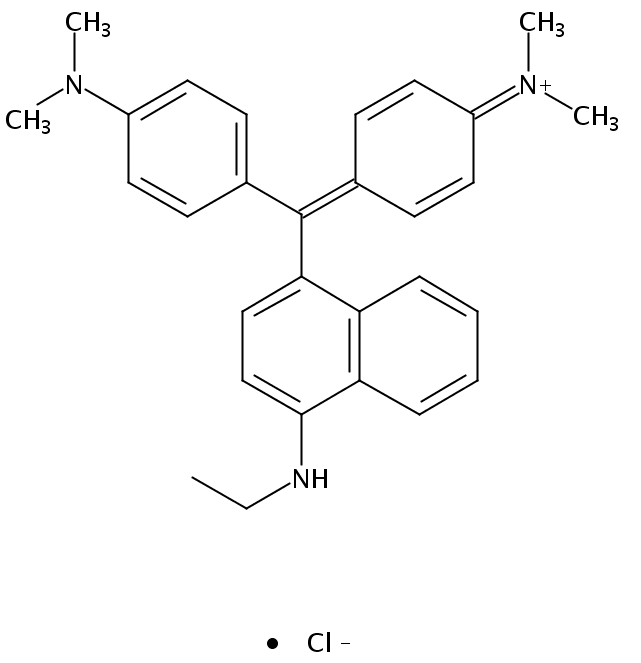
碱性蓝 11

碱性蓝 11 基本信息
CAS号 2185-86-6 分子式 C29H32ClN3
分子量 458.03700 精确质量  457.22800
PSA  18.28000 LogP  3.05560

基本信息 展开↓

CAS号:
2185-86-6
分子式:
C29H32ClN3
分子量:
458.03700
中文名称:
碱性蓝 11
英文名称:
Basic Blue 11
中文别名:
碱性蓝 11;
碱性蓝11
英文别名:
Basic Blue 11;
basicbluek;
Victoria Blue R;
C.I.Basicblue11;
VICTORIA BLUE R;
CIPIGMENTBLUE2;
victorialakebluer;
VICTORYBLUE;
victoriabluers
精确分子量/精确质量:
457.22800
极性分子表面积/PSA:
18.28000
油水分配系数/LogP:

LogP值指的是某物质在正辛醇/水两相体系中的分配系数的对数值,反映了物质在油水两相中的分配情况。其中、LogP值越大,说明该物质越亲油;反之,LogP值越小,则说明该物质越亲水。
贝尔斯坦号/MDL:
MFCD00011876
EINECS:
218-572-7
PubChem:
24854026
InChI:
InChI=1/C29H31N3.ClH/c1-6-30-28-20-19-27(25-9-7-8-10-26(25)28)29(21-11-15-23(16-12-21)31(2)3)22-13-17-24(18-14-22)32(4)5;/h7-20H,6H2,1-5H3;1H/b30-28+;

生产制备方法及用途展开↓

制备方法


采用4,4'-二(二甲氨基)二苯甲酮(即四甲基米氏酮),在三氯氧磷作用下,与N-乙基甲萘胺缩合,然后经水解、担纯,盐析,过滤及干燥即得成品。公斤/吨四甲基米氏酮 268N-乙基甲萘胺 170三氯氧磷 167氢氧化钠 204氯仿 40

合成制备方法


采用44'-二(二甲氨基)二苯甲酮(即四甲基米氏酮),在三氯氧磷作用下,与N-乙基甲萘胺缩合,然后经水解、担纯,盐析,过滤及干燥即得成品。公斤/吨四甲基米氏酮 268N-乙基甲萘胺 170三氯氧磷 167氢氧化钠 204氯仿 40

用途简介


主要用于制备碱性品蓝色沉淀,其次用于棉布的印花,麻、蚕丝织物及皮革、竹、木等的染色。

用途


主要用于制备碱性品蓝色沉淀,其次用于棉布的印花,麻、蚕丝织物及皮革、竹、木等的染色。

物化性质展开↓

外观与性状:
暗蓝色粉末
沸点:
571.3ºC at 760 mmHg
闪点:
299.3ºC
水溶解性:
0.5 g/L (20 ºC)
蒸汽压:
4.62E-13mmHg at 25°C
存储条件/存储方法:

密封储存,储存于阴凉、干燥的库房。

稳定性相关:

常温常压下稳定。

其它信息:

1.      性状:深蓝色无味的结晶性粉末

2.      密度(g/mL,25):未确定

3.      相对蒸汽密度(g/mL,空气=1):未确定

4.      熔点(ºC):未确定

5.      沸点(ºC,常压):未确定

6.      沸点(ºC,4mmHg):未确定

7.      折射率(n20/D):未确定

8.      闪点(ºC):未确定

9.      比旋光度(º):未确定

10.   自燃点或引燃温度(ºC):未确定

11.   蒸气压(mPa,20ºC):未确定

12.   饱和蒸气压(kPa,25ºC):未确定

13.   燃烧热(KJ/mol):未确定

14.   临界温度(ºC):未确定

15.   临界压力(KPa):未确定

16.   油水(辛醇/水)分配系数的对数值:未确定

17.   爆炸上限(%,V/V):未确定

18.   爆炸下限(%,V/V):未确定

19.   溶解性:微溶于冷水,溶于热水,易溶于乙醇

安全信息展开↓

危险类别码:
R22
安全说明:
S36
RTECS号:
PA0780300
安全标志:
S36:穿戴合适的防护服装。
危险标志:
Xn:Harmful;

毒理性展开↓

CHEMICAL IDENTIFICATION

RTECS NUMBER :
PA0780300
CHEMICAL NAME :
Methanaminium, N-(4-((4-(dimethylamino)phenyl)(4-(ethylamino)-1-naph thalenyl)methylene)- 2,5-cyclohexadien-1-ylidene)-N-methyl-, chloride
CAS REGISTRY NUMBER :
2185-86-6
LAST UPDATED :
199701
DATA ITEMS CITED :
11
MOLECULAR FORMULA :
C29-H32-N3.Cl
MOLECULAR WEIGHT :
458.09

HEALTH HAZARD DATA

ACUTE TOXICITY DATA

TYPE OF TEST :
LD50 - Lethal dose, 50 percent kill
ROUTE OF EXPOSURE :
Oral
SPECIES OBSERVED :
Rodent - rat
DOSE/DURATION :
960 mg/kg
TOXIC EFFECTS :
Details of toxic effects not reported other than lethal dose value
TYPE OF TEST :
LD50 - Lethal dose, 50 percent kill
ROUTE OF EXPOSURE :
Subcutaneous
SPECIES OBSERVED :
Rodent - rat
DOSE/DURATION :
1408 mg/kg
TOXIC EFFECTS :
Details of toxic effects not reported other than lethal dose value
TYPE OF TEST :
LD50 - Lethal dose, 50 percent kill
ROUTE OF EXPOSURE :
Unreported
SPECIES OBSERVED :
Rodent - rat
DOSE/DURATION :
2340 mg/kg
TOXIC EFFECTS :
Details of toxic effects not reported other than lethal dose value
TYPE OF TEST :
LD50 - Lethal dose, 50 percent kill
ROUTE OF EXPOSURE :
Oral
SPECIES OBSERVED :
Rodent - mouse
DOSE/DURATION :
750 mg/kg
TOXIC EFFECTS :
Behavioral - changes in motor activity (specific assay) Behavioral - muscle weakness
TYPE OF TEST :
LD50 - Lethal dose, 50 percent kill
ROUTE OF EXPOSURE :
Oral
SPECIES OBSERVED :
Rodent - hamster
DOSE/DURATION :
1409 mg/kg
TOXIC EFFECTS :
Behavioral - changes in motor activity (specific assay) Behavioral - muscle weakness
TYPE OF TEST :
TDLo - Lowest published toxic dose
ROUTE OF EXPOSURE :
Oral
SPECIES OBSERVED :
Rodent - rat
DOSE/DURATION :
3978 mg/kg/17W-I
TOXIC EFFECTS :
Endocrine - changes in thymus weight Liver - changes in liver weight Blood - changes in erythrocyte (RBC) count
TYPE OF TEST :
TDLo - Lowest published toxic dose
ROUTE OF EXPOSURE :
Oral
SPECIES OBSERVED :
Rodent - rat
DOSE/DURATION :
9360 mg/kg/40D-C
TOXIC EFFECTS :
Blood - methemoglobinemia-carboxyhemoglobin Blood - changes in leukocyte (WBC) count Biochemical - Enzyme inhibition, induction, or change in blood or tissue levels - true cholinesterase
TYPE OF TEST :
TDLo - Lowest published toxic dose
ROUTE OF EXPOSURE :
Oral
SPECIES OBSERVED :
Rodent - rat
DOSE/DURATION :
4944 mg/kg/73W-I
TOXIC EFFECTS :
Tumorigenic - Carcinogenic by RTECS criteria Kidney, Ureter, Bladder - Kidney tumors Blood - lymphoma, including Hodgkin's disease
TYPE OF TEST :
TDLo - Lowest published toxic dose
ROUTE OF EXPOSURE :
Subcutaneous
SPECIES OBSERVED :
Rodent - rat
DOSE/DURATION :
2361 mg/kg/66W-I
TOXIC EFFECTS :
Tumorigenic - Carcinogenic by RTECS criteria Tumorigenic - tumors at site of application

MUTATION DATA

TYPE OF TEST :
Mutation in microorganisms
TEST SYSTEM :
Yeast - Saccharomyces cerevisiae
DOSE/DURATION :
10 mg/L
REFERENCE :
VINIT* Vsesoyuznyi Institut Nauchnoi i Tekhnicheskoi Informatsii (VINITI). All-Union Institute of Scientific and Technical Information. (Moscow, USSR) Use information broker to obtain publications. Volume(issue)/page/year: #428-84

MSDS 展开↓

Name: Victoria Blue R Material Safety Data Sheet
Synonym: Basic Blue 11; C.I. 4404
CAS: 2185-86-6
Section 1 - Chemical Product   MSDS Name:Victoria Blue R Material Safety Data Sheet
Synonym:Basic Blue 11; C.I. 4404

Section 2 - COMPOSITION, INFORMATION ON INGREDIENTS
CAS# Chemical Name content EINECS#
2185-86-6 Victoria Blue R 218-572-7
Hazard Symbols: XN
Risk Phrases: 22

Section 3 - HAZARDS IDENTIFICATION
  EMERGENCY OVERVIEW
Harmful if swallowed.The toxicological properties of this material have not been fully investigated.
Potential Health Effects
Eye:
May cause eye irritation.
Skin:
May cause skin irritation.
Ingestion:
May cause irritation of the digestive tract. The toxicological properties of this substance have not been fully investigated. May be harmful if swallowed.
Inhalation:
May cause respiratory tract irritation. The toxicological properties of this substance have not been fully investigated.
Chronic:
No information found.

Section 4 - FIRST AID MEASURES
  Eyes: Flush eyes with plenty of water for at least 15 minutes, occasionally lifting the upper and lower eyelids. Get medical aid.
Skin:
Get medical aid. Flush skin with plenty of water for at least 15 minutes while removing contaminated clothing and shoes. Wash clothing before reuse.
Ingestion:
Never give anything by mouth to an unconscious person. Get medical aid. Do NOT induce vomiting. If conscious and alert, rinse mouth and drink 2-4 cupfuls of milk or water. Wash mouth out with water.
Inhalation:
Remove from exposure and move to fresh air immediately. If breathing is difficult, give oxygen. Get medical aid. Do NOT use mouth-to-mouth resuscitation. If breathing has ceased apply artificial respiration using oxygen and a suitable mechanical device such as a bag and a mask.
Notes to Physician:
Treat symptomatically and supportively.

Section 5 - FIRE FIGHTING MEASURES
  General Information:
As in any fire, wear a self-contained breathing apparatus in pressure-demand, MSHA/NIOSH (approved or equivalent), and full protective gear. During a fire, irritating and highly toxic gases may be generated by thermal decomposition or combustion. Dust can be an explosion hazard when exposed to heat or flame. Runoff from fire control or dilution water may cause pollution.
Extinguishing Media:
Use water spray, dry chemical, carbon dioxide, or chemical foam. Use agent most appropriate to extinguish fire.

Section 6 - ACCIDENTAL RELEASE MEASURES
  General Information: Use proper personal protective equipment as indicated in Section 8.
Spills/Leaks:
Vacuum or sweep up material and place into a suitable disposal container. Clean up spills immediately, observing precautions in the Protective Equipment section. Avoid generating dusty conditions.
Provide ventilation.

Section 7 - HANDLING and STORAGE
  Handling:
Wash thoroughly after handling. Remove contaminated clothing and wash before reuse. Use with adequate ventilation. Minimize dust generation and accumulation. Avoid breathing dust, vapor, mist, or gas. Avoid contact with eyes, skin, and clothing. Keep container tightly closed. Avoid ingestion and inhalation.
Storage:
Keep container closed when not in use. Store in a tightly closed container. Store in a cool, dry, well-ventilated area away from incompatible substances.

Section 8 - EXPOSURE CONTROLS, PERSONAL PROTECTION
  Engineering Controls:
Facilities storing or utilizing this material should be equipped with an eyewash facility and a safety shower. Use adequate ventilation to keep airborne concentrations low.
Exposure Limits CAS# 2185-86-6: Personal Protective Equipment Eyes: Wear appropriate protective eyeglasses or chemical safety goggles as described by OSHA's eye and face protection regulations in 29 CFR 1910.133 or European Standard EN166.
Skin:
Wear appropriate protective gloves to prevent skin exposure.
Clothing:
Wear appropriate protective clothing to prevent skin exposure.
Respirators:
Follow the OSHA respirator regulations found in 29 CFR 1910.134 or European Standard EN 149. Use a NIOSH/MSHA or European Standard EN 149 approved respirator if exposure limits are exceeded or if irritation or other symptoms are experienced.

Section 9 - PHYSICAL AND CHEMICAL PROPERTIES
 
Physical State: Crystalline powder
Color: dark blue
Odor: odorless
pH: 2.4 (1% aq. sol.)
Vapor Pressure: Not available.
Viscosity: Not available.
Boiling Point: Not available.
Freezing/Melting Point: Not available.
Autoignition Temperature: Not available.
Flash Point: Not available.
Explosion Limits, lower: Not available.
Explosion Limits, upper: Not available.
Decomposition Temperature: > 170 deg C
Solubility in water: 0.5 g/l (20C)
Specific Gravity/Density:
Molecular Formula: C29H32ClN3
Molecular Weight: 458.03

Section 10 - STABILITY AND REACTIVITY
  Chemical Stability:
Stable at room temperature in closed containers under normal storage and handling conditions.
Conditions to Avoid:
Incompatible materials, dust generation, excess heat, strong oxidants.
Incompatibilities with Other Materials:
Oxidizing agents.
Hazardous Decomposition Products:
Hydrogen chloride, nitrogen oxides, carbon monoxide, irritating and toxic fumes and gases, carbon dioxide.
Hazardous Polymerization: Will not occur.

Section 11 - TOXICOLOGICAL INFORMATION
  RTECS#:
CAS# 2185-86-6: PA0780300 LD50/LC50:
CAS# 2185-86-6: Oral, mouse: LD50 = 750 mg/kg; Oral, rat: LD50 = 960 mg/kg.
Carcinogenicity:
Victoria Blue R - Not listed by ACGIH, IARC, or NTP.
Other:
See actual entry in RTECS for complete information.

Section 12 - ECOLOGICAL INFORMATION
 

Section 13 - DISPOSAL CONSIDERATIONS
  Dispose of in a manner consistent with federal, state, and local regulations.

Section 14 - TRANSPORT INFORMATION
 
IATA
Shipping Name: Not regulated.
Hazard Class:
UN Number:
Packing Group:
IMO
Shipping Name: Not regulated.
Hazard Class:
UN Number:
Packing Group:
RID/ADR
Shipping Name: Not regulated.
Hazard Class:
UN Number:
Packing group:

Section 15 - REGULATORY INFORMATION
 
European/International Regulations
European Labeling in Accordance with EC Directives
Hazard Symbols: XN
Risk Phrases:
R 22 Harmful if swallowed.
Safety Phrases:
S 24/25 Avoid contact with skin and eyes.
WGK (Water Danger/Protection)
CAS# 2185-86-6: No information available.
Canada
CAS# 2185-86-6 is listed on Canada's NDSL List.
CAS# 2185-86-6 is not listed on Canada's Ingredient Disclosure List.
US FEDERAL
TSCA
CAS# 2185-86-6 is listed on the TSCA inventory.


SECTION 16 - ADDITIONAL INFORMATION
N/A

分子结构与计算化学数据展开↓

计算化学数据


1.疏水参数计算参考值(XlogP):无

2.氢键供体数量:1

3.氢键受体数量:3

4.可旋转化学键数量:5

5.互变异构体数量:无

6.拓扑分子极性表面积20.4

7.重原子数量:33

8.表面电荷:0

9.复杂度:670

10.同位素原子数量:0

11.确定原子立构中心数量:0

12.不确定原子立构中心数量:0

13.确定化学键立构中心数量:0

14.不确定化学键立构中心数量:0

15.共价键单元数量:2

立即下载安装“化学加”APP
专业、功能强大,随时调用更加方便