Section 1. Chemical Product and Company Identification
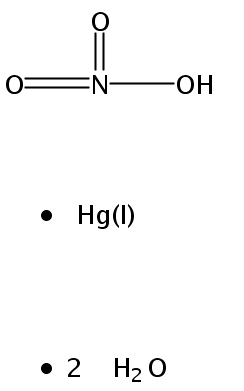
Mercurous Nitrate, Dihydrate
Common Name/
Trade Name
Mercurous Nitrate, Dihydrate
Section 3. Hazards Identification
Very hazardous in case of skin contact (irritant), of eye contact (irritant), of ingestion. Hazardous in case of inhalation.
Potential Acute Health
Slightly hazardous in case of skin contact (permeator). Prolonged exposure may result in skin burns and ulcerations.
Effects
Over-exposure by inhalation may cause respiratory irritation. Severe over-exposure can result in death. Inflammation
of the eye is characterized by redness, watering, and itching. Skin inflammation is characterized by itching, scaling,
reddening, or, occasionally, blistering.
CARCINOGENIC EFFECTS: Not available.
Potential Chronic Health
MUTAGENIC EFFECTS: Not available.
Effects
TERATOGENIC EFFECTS: Not available.
DEVELOPMENTAL TOXICITY: Not available.
The substance may be toxic to kidneys, the nervous system, gastrointestinal tract, skin, central nervous system (CNS).
Repeated or prolonged exposure to the substance can produce target organs damage. Repeated exposure to a
highly toxic material may produce general deterioration of health by an accumulation in one or many human organs.
Section 4. First Aid Measures
Check for and remove any contact lenses. In case of contact, immediately flush eyes with plenty of water for at least
Eye Contact
15 minutes. Get medical attention immediately.
In case of contact, immediately flush skin with plenty of water for at least 15 minutes while removing contaminated
Skin Contact
clothing and shoes. Cover the irritated skin with an emollient. Wash clothing before reuse. Thoroughly clean shoes
before reuse. Get medical attention immediately.
Wash with a disinfectant soap and cover the contaminated skin with an anti-bacterial cream. Seek immediate
Serious Skin Contact
medical attention.
Inhalation If inhaled, remove to fresh air. If not breathing, give artificial respiration. If breathing is difficult, give oxygen. Get
medical attention.
Serious Inhalation Evacuate the victim to a safe area as soon as possible. Loosen tight clothing such as a collar, tie, belt or waistband.
If breathing is difficult, administer oxygen. If the victim is not breathing, perform mouth-to-mouth resuscitation. Seek
medical attention.
If swallowed, do not induce vomiting unless directed to do so by medical personnel. Never give anything by mouth to
Ingestion
an unconscious person. Loosen tight clothing such as a collar, tie, belt or waistband. Get medical attention
immediately.
Not available.
Serious Ingestion
Section 5. Fire and Explosion Data
Flammability of the Product Non-flammable.
Auto-Ignition Temperature Not applicable.
Not applicable.
Flash Points
Not applicable.
Flammable Limits
Not available.
Products of Combustion
Fire Hazards in Presence of of combustible materials of organic materials
Various Substances
Risks of explosion of the product in presence of mechanical impact: Not available.
Explosion Hazards in
Risks of explosion of the product in presence of static discharge: Not available.
Presence of Various
Substances
Not applicable.
Fire Fighting Media
and Instructions
Contact with combustible or organic materials may cause fire. When heated to decomposition it emits toxic fumes of
Special Remarks on
nitrogen oxides, mercury/mercury oxides
Fire Hazards
Contact with red hot carbon causes mild explosion.
Special Remarks on
Mixture of Mercurous nitrate and Phosphorus explodes violently when struck with hammer.
Explosion Hazards
Mercurous Nitrate, Dihydrate
Section 6. Accidental Release Measures
Use appropriate tools to put the spilled solid in a convenient waste disposal container.
Small Spill
Large Spill Oxidizing material. Poisonous solid.
Stop leak if without risk. Do not get water inside container. Avoid contact with a combustible material (wood, paper,
oil, clothing...). Keep substance damp using water spray. Do not touch spilled material. Use water spray to reduce
careful that the product is not present at a concentration level above TLV. Check TLV on the MSDS and with local
authorities.
Section 7. Handling and Storage
Keep away from heat. Keep away from sources of ignition. Keep away from combustible material.. Do not ingest.
Precautions
Do not breathe dust. In case of insufficient ventilation, wear suitable respiratory equipment. If ingested, seek medical
advice immediately and show the container or the label. Avoid contact with skin and eyes. Keep away from
incompatibles such as reducing agents, combustible materials, organic materials, metals.
Keep container tightly closed. Keep container in a cool, well-ventilated area. Separate from acids, alkalies,
Storage
reducing agents and combustibles. See NFPA 43A, Code for the Storage of Liquid and Solid Oxidizers. Sensitive to
light. Store in light-resistant containers.
Section 8. Exposure Controls/Personal Protection
Use process enclosures, local exhaust ventilation, or other engineering controls to keep airborne levels below
Engineering Controls
recommended exposure limits. If user operations generate dust, fume or mist, use ventilation to keep exposure to
airborne contaminants below the exposure limit.
Personal Protection Splash goggles. Lab coat. Dust respirator. Be sure to use an approved/certified respirator or equivalent. Gloves.
Personal Protection in Case Splash goggles. Full suit. Dust respirator. Boots. Gloves. A self contained breathing apparatus should be used to
avoid inhalation of the product. Suggested protective clothing might not be sufficient; consult a specialist BEFORE
of a Large Spill
handling this product.
Exposure Limits for Inorganic Mercury Compounds (as Hg):
Exposure Limits
TWA: 0.025 (mg(Hg)/m3) from ACGIH (TLV) [United States] SKIN (skin designation). Skin absorption as potential
significant contribution to overall exposure.
TWA: 0.1 (mg(Hg)/m3) from ACGIH (TLV) [United States] Inhalation
TWA: 0.1 (mg(Hg)/m3) from NIOSH [United States] SKIN (skin designation). Skin absorption as potential significant
contribution to overall exposure.
TWA: 0.1 (mg(Hg)/m3) from OSHA (PEL) [United States] Inhalation
TWA: 0.05 STEL: 0.15 (mg(Hg)/m3) [United Kingdom (UK)]
Consult local authorities for acceptable exposure limits.
Section 9. Physical and Chemical Properties
Solid. (Crystals solid.) Not available.
Physical state and O dor
appearance
Not available.
Taste
561.22 g/mole
Molecular Weight
Not available.
Color
Not available.
pH (1% soln/water)
Not available.
Boiling Point
Decomposition temperature: 70°C (158°F)
Melting Point
Not available.
Critical Temperature
4.78 (Water = 1)
Specific Gravity
Not applicable.
Vapor Pressure
Not available.
Vapor Density
Not available.
Volatility
Not available.
Odor Threshold
Mercurous Nitrate, Dihydrate
Not available.
Water/Oil Dist. Coeff.
Not available.
Ionicity (in Water)
Not available.
Dispersion Properties
Soluble in 13 parts water containing 1% Nitric acid..
Solubility
Insoluble in ammonium hydroxide.
Section 10. Stability and Reactivity Data
The product is stable.
Stability
Not available.
Instability Temperature
Conditions of Instability Incompatible materials
Incompatibility with various Reactive with reducing agents, combustible materials, organic materials, metals, acids.
substances
Non-corrosive in presence of glass.
Corrosivity
Effloresces and becomes anhydrous in dry air.
Special Remarks on
Incompatible with phosphorus, ammonia, most common metals, strong reducing agents, combustible materials,
Reactivity
organic materials, cyanide, thiocyanates, isothiocyanates, hypophosphites, hyphosphoric acid
Not available.
Special Remarks on
Corrosivity
Will not occur.
Polymerization
Section 11. Toxicological Information
Absorbed through skin. Inhalation. Ingestion.
Routes of Entry
Toxicity to Animals Acute oral toxicity (LD50): 49.3 mg/kg [Mouse].
Acute dermal toxicity (LD50): 2330 mg/kg [Rat].
Chronic Effects on Humans May cause damage to the following organs: kidneys, the nervous system, gastrointestinal tract, skin, central nervous
system (CNS).
Very hazardous in case of skin contact (irritant), of ingestion.
Other Toxic Effects on
Humans Hazardous in case of inhalation.
Slightly hazardous in case of skin contact (permeator).
Not available.
Special Remarks on
Toxicity to Animals
May cause adverse reproductive effects and birth defects (teratogenic)
Special Remarks on
Chronic Effects on Humans
Acute Potential Health Effects:
Special Remarks on other
Skin: Causes irritation and possible burns. It can be absorbed through the skin with symptoms similar to ingestion.
Toxic Effects on Humans
Harmful if absorbed through skin.
Eyes: Causes irritation with possible burns and eye damage.
Inhalation: Can cause respiratory tract (nose, throat, lung) irritation causing sore throat, coughing, tightness in chest,
breathing difficulities, and/or shortness of breath. Pneumonitis may develop.
Ingestion: Toxic. Harmful if swallowed. May cause burining of the mouth and pharynx. Can cause salivation,
metallic taste, abdominal pain, nausea, vomiting, hypermotility, bloody diarrhea. May affect the kidneys
(proteinuria, acute renal failure).
Inhalation/Ingestion: High or repeated exposure can cause Mercury poisoning. Mercury poisoning causes sore gums,
personality changes, tremor/"shakes" (often with shaky handwriting), clumsiness, fatigue, irritability and increased
saliva. Other changes may include serious personality changes memory loss, extreme shyness, weakness, stomatitis,
gingivitis, loss of teeth, gastrointestinal disturbances, metallic taste, poor appetite/anorexia, weight loss, "pins and
needles" (peripheral neuropathy). Exposures can also affect the liver, cause kidney damage, and may cause
decreased visual acuity, and affect peripheral vision (the ability to see to the side). Brain damage can occur,
especially if exposure continues.
Chronic Potential Health Effects
Mercurous Nitrate, Dihydrate
Inhalation/Ingestion: High or repeated exposure can cause Mercury poisoning. See above for symtoms of Mercury
poisoning.
Eye Contact: brown staining in the eye without visual impairment.
Skin: Repeated skin contact can make the skin turn gray. Skin allergy/dermatitis can also occur. If this happens, even
small future exposures can cause rash.
Note: In addition to the effects of exposure to mercury, this product is also a nitrate. The first clinical signs associated
with nitrate poisoning include: Gastroenteritis, abdominal pain, nausea, vomiting(spontaneous vomiting), diarrhea,
metabolic acidosis. Purging and diuresis can be expected. The toxicity of nitrates is due to the in vivo conversion to
nitrites. The primary toxic effects of nitrites include orthostatic hypotension (due to perpheral vasodilation) and
methemoglobinemia (the formation of methemoglobin in the blood which causes deficient oxygenation of the blood
due to decreased available hemoglobin). Other symptoms may include muscular weakness, dizziness, lightheadness,
fatigue, throbbing headache, mental impairment, incoordination, seizures convulsions, bradycardia or tachydardia
(slow or fast heart beat), dysrhythmias, dyspnea. Furthermore, methemoglobinemia due to inadequate oxygenation
of the blood can lead to progressive cyanosis, and coma. Cyanosis is first visible as a bluish discoloration of the
mucous membranes and unpigmented areas of the body. Prolonged or repeated ingestion of large amounts of
nitrates may affect the liver and can cause nausea, vomiting, anorexia/weight loss, methemoglobinemia
(characterized by dizziness, rapid or slow heart beat, irregular breathing, convulsions), and possible coma and death.
Section 12. Ecological Information
Not available.
Ecotoxicity
Not available.
BOD5 and COD
Products of Biodegradation Possibly hazardous short term degradation products are not likely. However, long term degradation products may
arise.
The products of degradation are less toxic than the product itself.
Toxicity of the Products
of Biodegradation
Not available.
Special Remarks on the
Products of Biodegradation
Section 13. Disposal Considerations
Waste must be disposed of in accordance with federal, state and local environmental control
Waste Disposal
regulations.
Section 14. Transport Information
CLASS 6.1: Poisonous material.
DO T Cl assi fi cati on
: Mercurous nitrate UNNA: 1627 PG: II
Identification
Marine Pollutant
Special Provisions for
Transport
DO T (Pi ctograms)
Section 15. Other Regulatory Information and Pictograms
California prop. 65: This product contains the following ingredients for which the State of California has found to
Federal and State
cause cancer, birth defects or other reproductive harm, which would require a warning under the statute: Mercurous
Regulations
Nitrate, Dihydrate (Listed as Mercury and Mercury compounds)
California prop. 65: This product contains the following ingredients for which the State of California has found to
cause birth defects which would require a warning under the statute: Mercurous Nitrate, Dihydrate (Listed as Mercury
and Mercury compounds)
Connecticut hazardous material survey.: Mercurous Nitrate (CAS number 10415-75-5)
Illinois chemical safety act: Mercurous Nitrate (CAS number 10415-75-5)
New York release reporting list: Mercurous Nitrate (CAS number 10415-75-5)
Pennsylvania RTK: Mercurous Nitrate (CAS number 10415-75-5)
Massachusetts RTK: Mercurous Nitrate (CAS number 10415-75-5)
Mercurous Nitrate, Dihydrate
Massachusetts spill list: Mercurous Nitrate (CAS number 10415-75-5)
New Jersey: Mercurous Nitrate (CAS number 10415-75-5)
New Jersey spill list: Mercurous Nitrate (CAS number 10415-75-5)
Louisiana spill reporting: Mercurous Nitrate (CAS number 10415-75-5)
California Director's List of Hazardous Substances: Mercurous Nitrate (CAS number 10415-75-5)
SARA 313 toxic chemical notification and release reporting: Mercurous Nitrate, Dihydrate (Listed as Mercury and
Mercury compounds)
CERCLA: Hazardous substances.: Mercurous Nitrate: 10 lbs. (4.536 kg)
California prop. 65: This product contains the following ingredients for which the State of California has found to
California
cause cancer which would require a warning under the statute: No products were found.
Proposition 65
Warnings
California prop. 65: This product contains the following ingredients for which the State of California has found to
cause birth defects which would require a warning under the statute: Mercurous Nitrate, Dihydrate (Listed as Mercury
and Mercury compounds)
OSHA: Hazardous by definition of Hazard Communication Standard (29 CFR 1910.1200).
Other Regulations
The classification of this product has not been validated yet by the Service du repertoire
Other Classifications WHMIS (Canada)
toxicologique. However, it might be classified as:
CLASS C: Oxidizing material.
CLASS D-1A: Material causing immediate and serious toxic effects (VERY TOXIC).
CLASS D-2B: Material causing other toxic effects (TOXIC).
R8- Contact with combustible material S26- In case of contact with eyes, rinse
DSCL (EEC)
may cause fire. immediately with plenty of water and seek
R20/21- Harmful by inhalation and in medical advice.
contact with skin. S36/37/39- Wear suitable protective clothing,
R25- Toxic if swallowed. gloves and eye/face protection.
R33- Danger of cumulative effects. S45- In case of accident or if you feel unwell,
R36/38- Irritating to eyes and skin. seek medical advice immediately (show the
R50/53- Very toxic to aquatic label where possible).
organisms, may cause long-term S60- This material and its container must be
adverse effects in the aquatic disposed of as hazardous waste.
environment. S61- Avoid release to the environment. Refer to
special instructions/Safety data sheets.
HMIS (U.S.A.) Health Hazard 3 National Fire Protection
0 Flammability
0 Association (U.S.A.)
Fire Hazard
3 0 Reactivity
Health
Reactivity
0
Specific hazard
Personal Protection
E
WHMIS (Canada)
(Pictograms)
DSCL (Europe)
(Pictograms)
TDG(Canada)
(Pictograms)
ADR (Europe)
(Pictograms)
Mercurous Nitrate, Dihydrate
Protective Equipment
Gloves.
Lab coat.
Dust respirator. Be sure to use an
approved/certified respirator or equivalent.
Wear appropriate respirator when ventilation
is inadequate.
SECTION 16 - ADDITIONAL INFORMATION
N/A


 基本信息
展开↓
基本信息
展开↓  生产制备方法及用途展开↓
 物化性质展开↓
  安全信息展开↓
  毒理性展开↓
  MSDS 展开↓
 分子结构与计算化学数据展开↓